
On-premise architecture
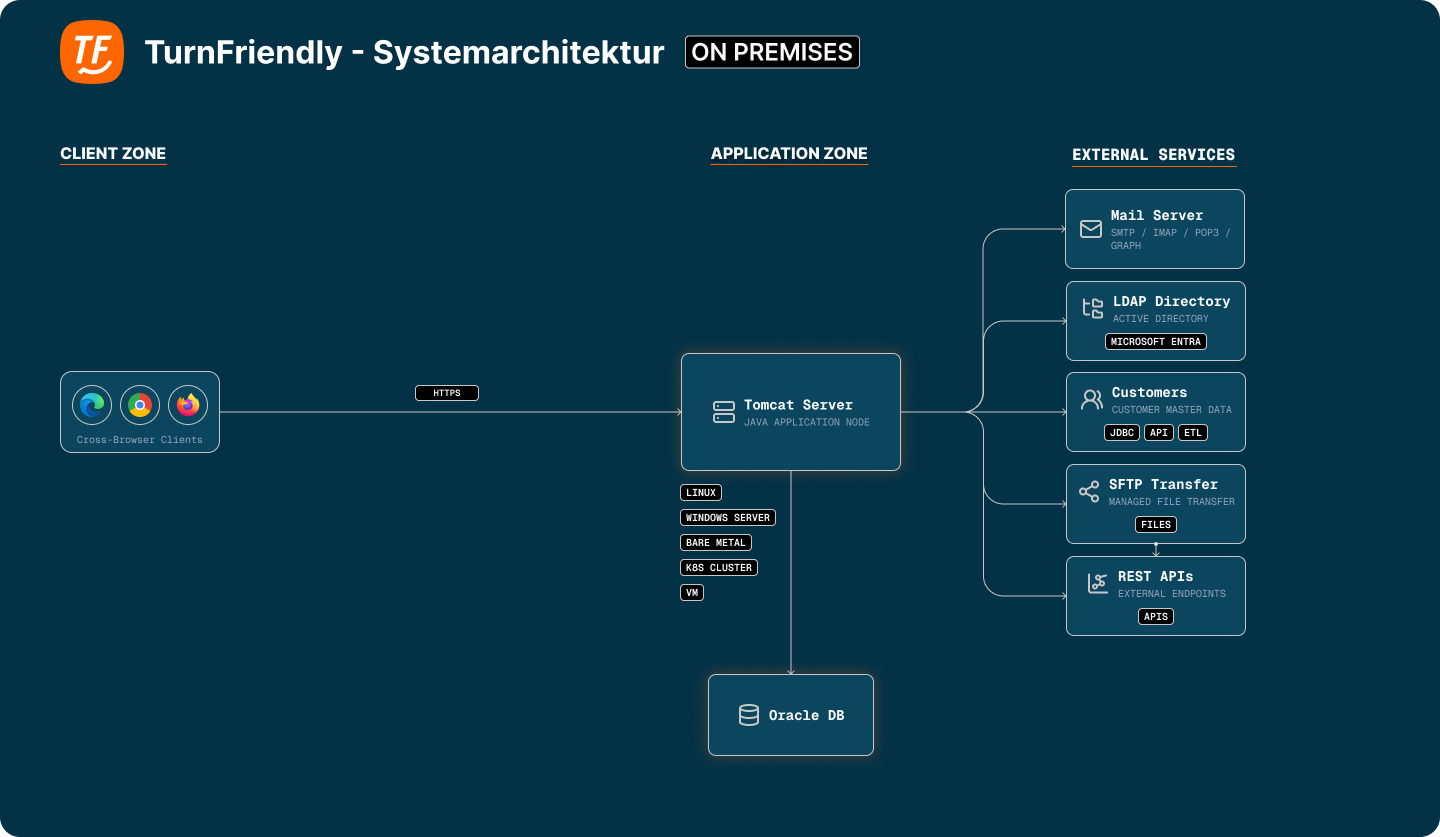
Open original view
Click the architecture to enlarge the details.
Cloud or On-Premises
In your own data centre or in the TurnFriendly Cloud: choose the deployment model that fits your IT requirements, existing infrastructure and available resources.
YOUR IT TEAM
Use your existing infrastructure and keep operations with your IT team.
TURNFRIENDLY
TurnFriendly handles technical operations, reducing the workload for your IT team.
Two deployment models
The platform remains TurnFriendly. You decide who is responsible for infrastructure and day-to-day operations.
Responsibility | On-premises | TurnFriendly Cloud |
|---|---|---|
Infrastructure | On-premises Your data centre; existing Oracle servers can be used. | TurnFriendly Cloud Oracle Cloud Infrastructure (OCI), Frankfurt. |
Installation | On-premises Your IT team, assisted by TurnFriendly Support. | TurnFriendly Cloud TurnFriendly sets up the cloud environment. |
Monitoring and backups | On-premises Your IT team. | TurnFriendly Cloud TurnFriendly. |
Releases | On-premises Your IT team with TurnFriendly Support. | TurnFriendly Cloud TurnFriendly deploys new releases. |
Architecture and requirements
TurnFriendly runs in the browser and supports deployment on virtual machines or in containers. Existing Oracle database servers can be used for on-premise deployment.
Open original view
Click the architecture to enlarge the details.
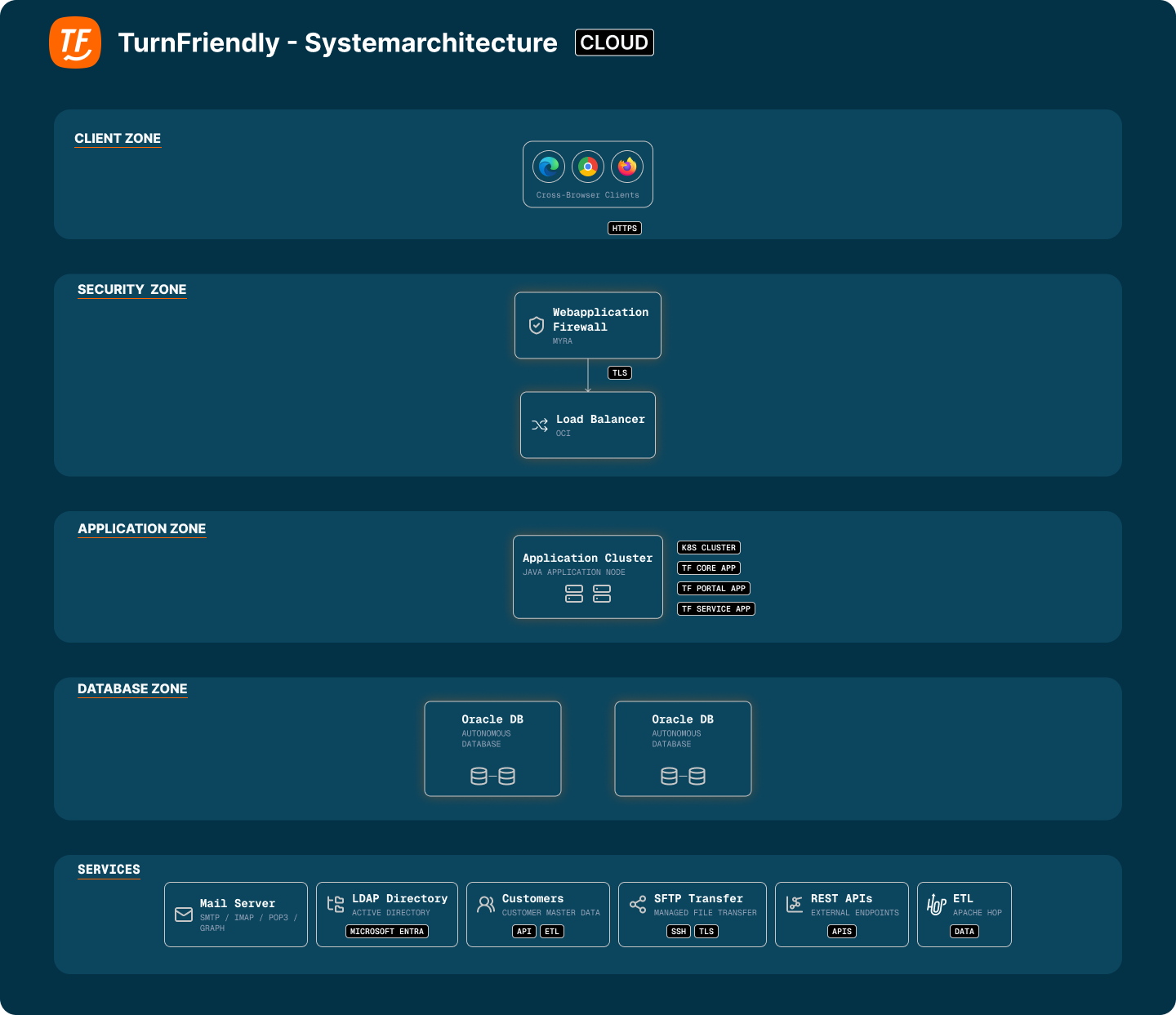
Open original view
Click the architecture to enlarge the details.
Customer-specific single sign-on as well as LDAP and Active Directory are supported. Mail servers, REST APIs, SFTP and data exchange through ETL can be connected to your existing systems.
Browser access uses HTTPS. Database connections remain internal. Depending on requirements, site-to-site VPN or Oracle FastConnect can connect cloud deployment to internal systems. User access alone requires an internet connection.
On-premises, your IT team integrates Tomcat into its monitoring using JMX and application logs.
On-premise, your IT team is responsible for backing up the database and application directory. In the cloud, TurnFriendly manages backups. Intervals, retention and recovery requirements are agreed for the chosen environment. SLA response times are not guaranteed recovery times.
A test environment is required for new versions and acceptance testing. On-premise, your IT team updates production with assistance from TurnFriendly Support. In the cloud, TurnFriendly deploys new releases.
These resources are recommendations for on-premise deployment. Actual sizing depends on user numbers, data volume and load profile. We agree sizing and licensing with your IT team. A separate test system is required.
Costs and service
Your own infrastructure, Oracle licences where required, and your IT team's work for operations, maintenance and backups. TurnFriendly support is offered according to scope.
We calculate Oracle infrastructure costs together with you using the Oracle Cost Estimator. Billing is based on actual consumption, with no markup. TurnFriendly Cloud Managed Services are quoted individually to match the agreed scope. Both cost components are additional to the software price.
The standard SLA defines availability, support hours and when incident handling begins. The agreed SLA governs the service.
The standard SLA provides for software availability of at least 99.5% per calendar month. Calculation takes the contractual exclusions into account.
Announced maintenance windows do not count as downtime. The SLA allows up to eight hours per month for maintenance. Maintenance is arranged outside usual business hours and, where possible, announced at least three working days in advance.
Further exclusions cover customer-caused incidents, external telecommunications or internet connections, force majeure and necessary IT security measures.
09:00–17:00 CET/CEST on working days. Public holidays at TurnFriendly’s registered office are excluded.
Response time starts when a complete report reaches the designated support channels. It means the start of incident handling, not final resolution or recovery.
Your next step
Talk to us about your requirements for deployment, user numbers, interfaces and identity management. Together, we will clarify responsibilities, technical checks and cost planning.
For internal discussions with IT, information security and procurement.